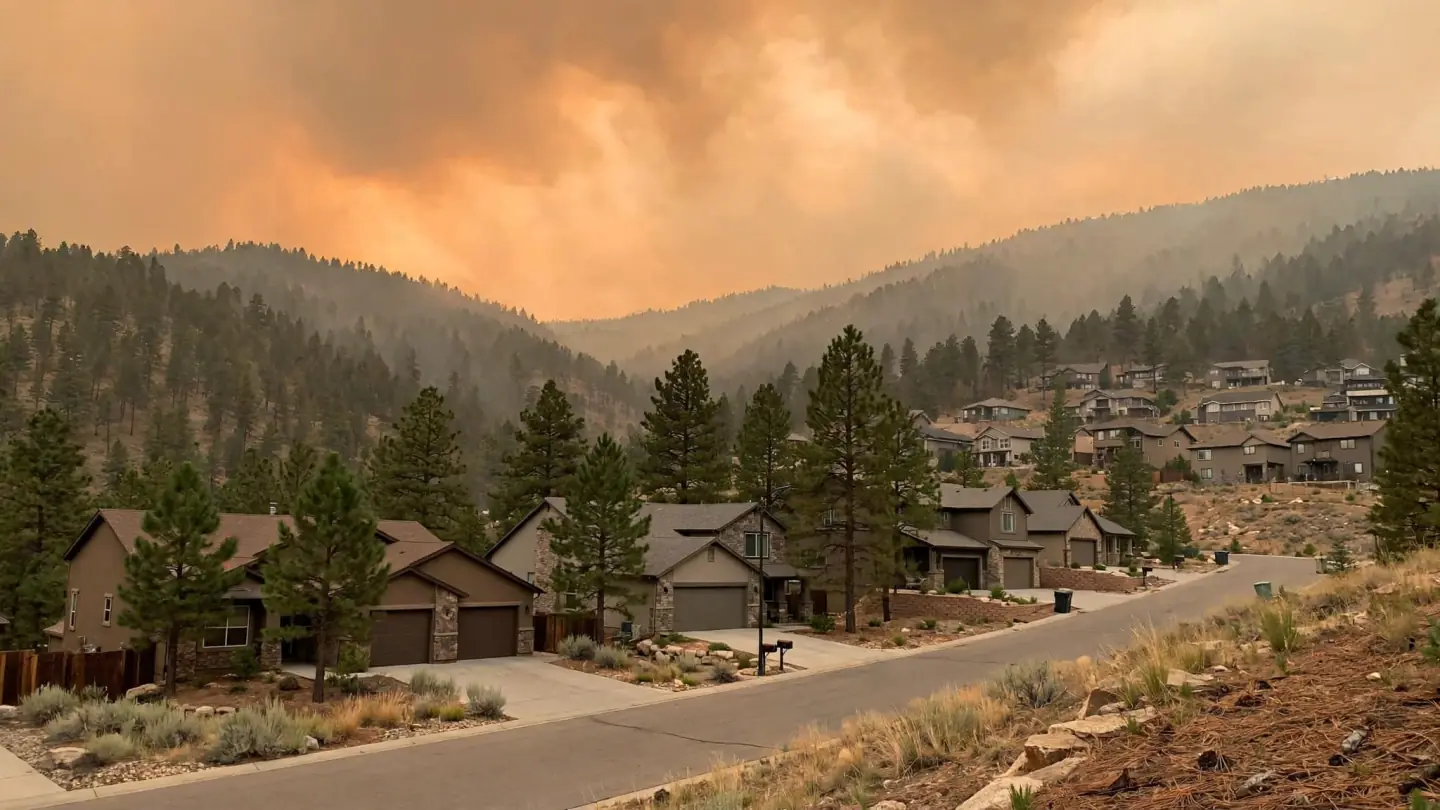
Key facts: Wildfire Smoke Damage
- Wildfire smoke and ash enter homes through gaps, vents and HVAC intakes, so houses far from the flames can need cleaning.
- The EPA advises against dry sweeping or blowing ash, and recommends HEPA vacuums, damp cleaning and a fitted N95 respirator.
- The 2012 Waldo Canyon Fire forced more than 32,000 people to evacuate and the 2013 Black Forest Fire about 35,500.
- Colorado Springs' wildland-urban interface runs along the western and southern foothills, with grassland fire risk on the east side.
How it gets in
How wildfire smoke and ash get inside a closed house
Even a well-built house exchanges air with the outside all the time. Air leaks around window sashes and door sweeps, through attic and soffit vents, around plumbing and wiring penetrations, through fireplace dampers and dryer vents, and in many homes through a fresh-air intake connected to the furnace. When a wildfire burns nearby, the outdoor air is thick with fine particles and gases, and that air is drawn in through every one of those openings. Wind makes it worse by pressurizing the side of the house facing the fire.
Wildfire smoke differs from the smoke inside a house fire. It has traveled, so the largest particles have usually dropped out, but the finest ones remain and they penetrate deeply into fabrics and filters. Ash and char from burned vegetation can also land on decks, roofs and in gutters and be tracked inside. Some of that ash contains residues from burned structures, vehicles and fences, not only trees and grass.
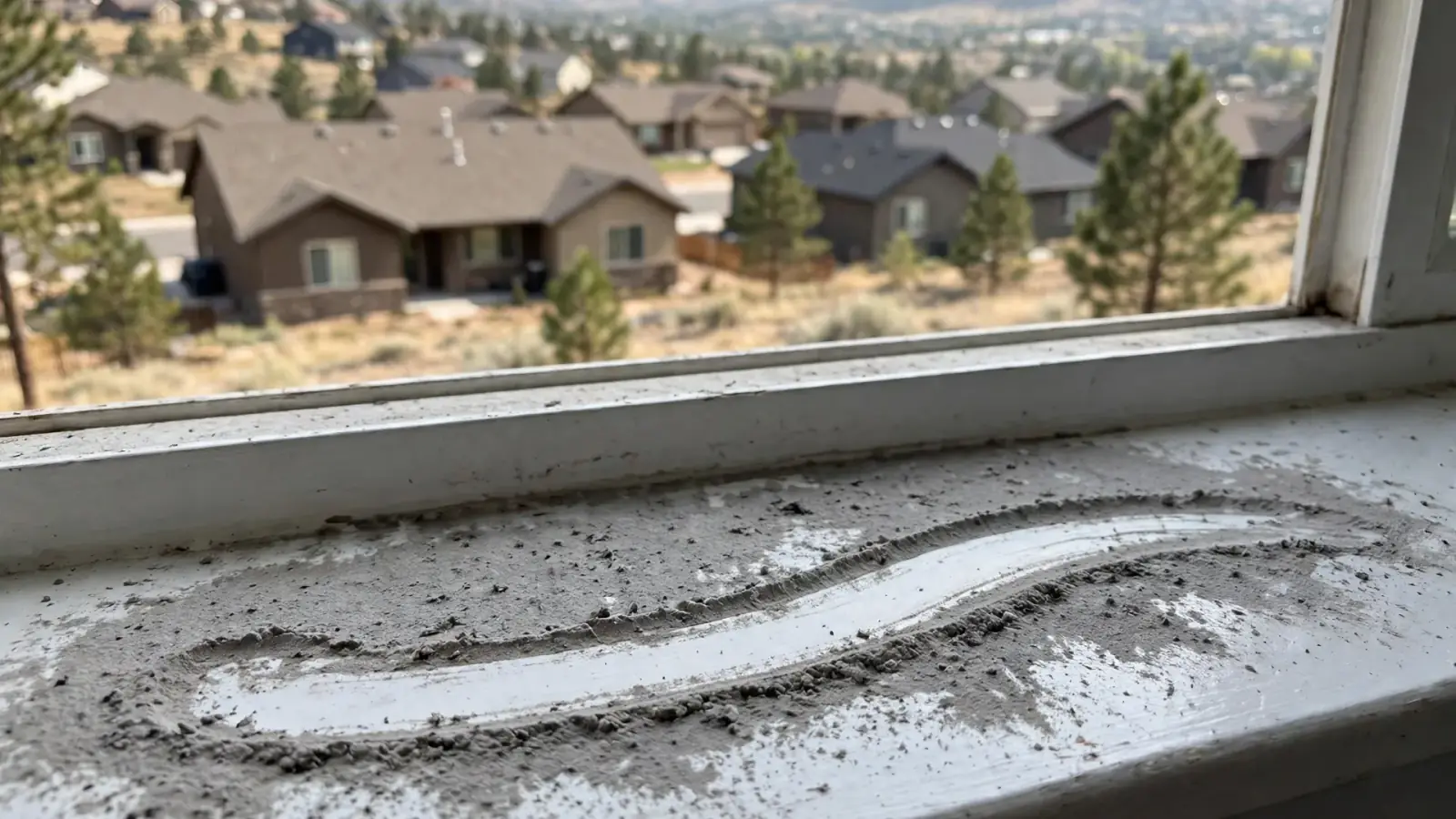
The result is usually widespread, thin contamination: a smell that fills the house, a gray film on window sills and in the garage, dirty furnace filters and dust that reappears after cleaning. It is a specialized form of smoke damage cleanup, with more emphasis on air, filters, ducts and soft goods than on heavy surface residue.
What you notice
Signs of wildfire smoke damage in a home
Smoke smell on returning
The house smells of campfire or burned brush when you come back after an evacuation, even with no visible damage.
Gray ash on sills and floors
Fine gray or black dust collects on window sills, near doors and in entryways.
Dark furnace filter
The filter turns gray or black far sooner than normal.
Ash in the garage and attic
Garages and attics, which exchange more air with the outside, often hold the most ash.
Smell in fabrics
Curtains, bedding, upholstery and clothing in closets smell of smoke.
Discolored exterior surfaces
Siding, decks and outdoor furniture show ash deposits or heat discoloration.
Local history
Wildfire smoke in Colorado Springs: recent history
Colorado Springs' two most destructive wildfires came a year apart. The Waldo Canyon Fire began west of the city on June 23, 2012, burned 18,247 acres and destroyed 346 homes, most of them when wind-driven flames swept into Mountain Shadows on June 26. [5] More than 32,000 residents of Colorado Springs, Manitou Springs and Woodland Park were evacuated. The Black Forest Fire began on June 11, 2013, northeast of the city, and destroyed about 500 homes in Black Forest, with about 35,500 people evacuated. [6]
In both fires, many more houses were exposed to smoke and ash than were burned. Gas service was shut off to about 4,200 undamaged homes in Mountain Shadows as a precaution, and restoring it took crews door to door. [7] Smoke from those fires, and from fires elsewhere in the West since then, has spread across neighborhoods far from the flames.
Not all local wildfire risk is in the forested foothills. In May 2022 a grass fire in Stetson Hills on the city's east side forced about 500 homes to evacuate. [8] Grass fires move fast in wind and send smoke straight into nearby houses.
Cleanup process
How wildfire smoke damage is cleaned
- 1
Wait for clean outdoor air
Cleaning starts once the fire is controlled and outdoor air quality has improved; otherwise new smoke undoes the work.
- 2
Change filters immediately
The furnace filter and any portable air cleaner filters are replaced, and the furnace fan is left off until the system is checked.
- 3
Remove ash outside first
Decks, entry areas, window wells and gutters near doors are cleared of ash with damp methods so it is not tracked inside again.
- 4
HEPA-vacuum interiors
Floors, carpets, upholstery, window tracks and vents are vacuumed with HEPA equipment, starting high and working down.
- 5
Damp-wipe hard surfaces
Walls, sills, cabinets, counters and fixtures are wiped with damp cloths and mild cleaners, changing water frequently.
- 6
Clean fabrics and contents
Drapes, bedding, clothing and upholstery are laundered or professionally cleaned; delicate items go out for specialist cleaning.
- 7
Inspect ducts and attic
Return ducts, the blower and attic insulation are checked for ash and cleaned or replaced as needed.
- 8
Treat remaining odor
After cleaning, remaining odor is treated with air scrubbing or other methods, and the house is checked closed up.
Surfaces and items
Wildfire smoke cleanup by surface and item
| Item or surface | Typical approach | Notes |
|---|---|---|
| Hard floors and counters | HEPA vacuum, then damp mop or wipe | Change water and cloths often |
| Carpet and rugs | HEPA vacuum; hot-water extraction if odor remains | Heavy ash may need professional cleaning |
| Upholstery | HEPA vacuum; professional cleaning for odor | Foam cushions hold smell |
| Clothing and bedding | Launder washable items; specialist cleaning for delicate items | Air-dry where possible |
| Walls and ceilings | Dry sponge where film is visible; damp wipe | Test in a corner first |
| Furnace and ducts | Filter change, blower inspection, duct cleaning if ash present | Run only with a fresh filter |
| Attic insulation | Inspect; remove and replace if heavily contaminated | Attic vents admit a lot of ash |
| Food and medicines | Discard anything exposed to heat, smoke or ash | Sealed cans exposed to heat too |
HVAC
Furnaces, ducts and outdoor air intakes after a wildfire
Heating and cooling systems are the biggest pathway for wildfire smoke into a house and the biggest reservoir of it afterward. If the furnace or air conditioner ran while smoke was outside, ash and fine particles were drawn into the return ducts and through the filter, and some passed into the supply ducts. A fresh-air intake brings outdoor air in directly. Evaporative coolers, common in some older Colorado homes, pull in large volumes of outside air and should be shut off when smoke is present.
The EPA recommends using the highest-efficiency filter your HVAC system can handle and running the system's fan to filter indoor air when outdoor air is smoky, as long as the system recirculates rather than bringing in outdoor air. [3] After the event, the filter should be replaced and the system inspected. If ash is found in the ducts or blower, cleaning them is part of the job rather than an optional add-on.
Attics and exteriors
Attics, vents and the outside of the house
Attics are ventilated by design, so they often collect more ash than living spaces. Ash settles on insulation and framing, and the smell can come down through ceiling light fixtures and attic hatches. A contractor should look in the attic as part of the assessment. Lightly dusted insulation may be left; heavily contaminated insulation is usually removed and replaced.
Outside, ash in gutters and on roofs can wash into downspouts and onto patios with the next rain or snowmelt, and it should be removed with damp methods. Siding, decks and outdoor furniture can usually be washed with low-pressure water and mild detergent. Heat may have damaged vinyl siding, window screens, vents and plastic fixtures on the side of the house facing the fire; note and photograph that damage for your insurer.
Homeowner checklist
What you can do yourself after wildfire smoke
- Return only when officials say it is safe, and check that utilities are on or wait for the utility to restore them.
- Change the furnace filter right away and keep the furnace fan off until you have checked it for ash.
- Run portable HEPA air cleaners in bedrooms and living areas.
- Use a HEPA vacuum on floors and upholstery, and damp-wipe hard surfaces; avoid dry dusting.
- Launder washable fabrics in batches, and set aside delicate or valuable items for professional cleaning.
- Throw away food left out or exposed to smoke, heat or ash.
- Photograph ash deposits, dirty filters, damage to the exterior and any items you discard.
- Wear an N95 respirator and gloves when handling ash, and keep children and pets away.
DIY or professional
Which wildfire smoke tasks to take on yourself
| Situation | Homeowner | Professional |
|---|---|---|
| Light ash on sills and floors, faint smell | Usually manageable with HEPA vacuum and damp wiping | Not usually needed |
| Smell throughout the house after a week of cleaning | Hard to resolve | Source tracing, duct and fabric cleaning, odor treatment |
| Ash in ducts or blower | No | Inspection and duct cleaning |
| Heavy ash in attic | No | Insulation removal and attic cleaning |
| Heat damage on exterior | Document only | Assessment and repair |
| House near burned homes, ash from structures | No | Professional cleanup with protective equipment |
Health
Health concerns after wildfire smoke exposure
Fine particles from wildfire smoke can irritate the eyes, nose and throat and worsen asthma, COPD and heart disease. Children, older adults, pregnant people and people with existing conditions are the most at risk. The EPA's guidance for indoor air during smoke events centers on reducing exposure: keep windows closed, filter the air with HEPA cleaners and high-efficiency HVAC filters, and avoid activities that add particles indoors, such as frying, vacuuming with non-HEPA vacuums, burning candles or using a wood stove.
Once the smoke has cleared outside, cleanup can create its own exposure by stirring up settled ash. That is why the methods above all aim to capture ash rather than move it, and why sensitive family members are better away while cleanup happens.
Insurance
Insurance claims for wildfire smoke without fire damage
Smoke and ash damage without flames can be harder to document than a burned house, so careful records matter. Photograph ash deposits, filters, exterior heat damage and affected belongings, keep a log of what you clean and what smells, and keep receipts for filters, cleaning supplies and any temporary housing. Many policies cover smoke damage from a wildfire, but terms vary; read your policy and talk to your insurer.
Colorado's Division of Insurance publishes guidance for policyholders after wildfires and evacuations. The guide working with your insurance adjuster covers how to prepare for the adjuster's visit.
Mitigation
Reducing wildfire smoke entry before the next fire
The Colorado Springs Fire Department maps the city's wildland-urban interface and requires ignition-resistant construction for new building there. [9] Residents can look up wildfire risk for an address on the city's site. Many of the same measures that keep embers out of a house also keep smoke and ash out: fine metal mesh over attic and crawlspace vents, tight-fitting doors and weatherstripping, closed fireplace dampers, and clean gutters.
Inside, a household plan for smoke days helps: know how to set your HVAC system to recirculate, keep spare high-efficiency filters, and have a portable HEPA cleaner for a bedroom that can serve as a clean room. NIST's research on fires in the wildland-urban interface shows that embers are a major way homes ignite, so vent screens and clearing flammable material close to the house also protect against fire itself. [10]
Neighborhoods
Where wildfire smoke damage is most likely in Colorado Springs
Homes on the western and southern edges of the city, near the foothills and open space, face the most direct wildfire exposure. That includes neighborhoods such as Mountain Shadows and Peregrine on the northwest side and Broadmoor on the slopes of Cheyenne Mountain. North of the city, Black Forest's ponderosa pine forest has its own history. On the east side, grasslands and open space between subdivisions can carry fast grass fires.
Smoke, though, travels much farther than fire. Neighborhoods across the city, from the Old North End to the east side, can be affected by smoke from fires in the foothills or elsewhere in the region.
Returning home
Returning home after a wildfire evacuation
- 1
Wait for the all-clear
Go back only when officials lift the evacuation order for your area, and follow any route instructions; roads may be blocked by crews and equipment.
- 2
Look before entering
Walk around the outside first. Look for heat damage, broken windows, downed lines, damaged propane tanks and smoldering debris, and call the fire department if anything is still smoking.
- 3
Check utilities
If gas was shut off by the utility, let them restore and relight it. If you smell gas, leave and call the utility from outside.
- 4
Ventilate carefully
If outdoor air is clean, open windows to air out the house; if the air is still smoky, keep them closed and run HEPA cleaners.
- 5
Document
Photograph each room, the attic hatch area, the furnace filter and the exterior before cleaning.
- 6
Plan the cleanup
Decide which tasks you can safely do and which need a contractor, and keep sensitive family members away until it is done.
Garages and vehicles
Ash in garages, cars and outbuildings
Garages are leaky by design, so they often collect more ash than any room in the house. Vehicles parked inside or outside during a wildfire can be coated with ash and may draw it into their cabin air systems. Workshops, sheds and barns hold stored items that absorb smoke. Clean garages with the same damp, HEPA-first approach, and avoid blowing ash out of the garage with a leaf blower, which spreads it to the next house.
For vehicles, a wash with plenty of water removes exterior ash, and the cabin air filter should be replaced. Ask your auto insurer about smoke damage to vehicles separately from your homeowners claim. Outbuildings with stored hay, feed or wood can hold smoke odor for a long time; ventilate them well and inspect stored materials before use.
Utilities
Gas, power and water after a wildfire evacuation
During large fires, utilities may shut off gas and electricity to whole neighborhoods as a precaution. After Waldo Canyon, Colorado Springs Utilities crews restored gas home by home, checking meters for leaks, purging air from the lines, relighting pilot lights and running safety tests, and they needed someone at each home to give permission. Expect the same kind of process after a large fire, and do not try to turn a utility-shut gas meter back on yourself.
If your water comes from a private well, as it does for many homes in Black Forest and other rural parts of El Paso County, check with county health guidance on testing after a wildfire, and inspect the wellhead and any electrical equipment for heat damage. Refrigerators and freezers that lost power for a long period should be emptied and cleaned before use.
FAQ
Wildfire smoke damage questions
Can wildfire smoke damage a house that did not burn?
Yes. Smoke and fine ash enter through gaps, vents and the HVAC system, leaving odor, ash deposits and residue that need cleaning.
How do I clean wildfire ash inside my house?
Use a HEPA vacuum and damp cloths, start high and work down, change water often and wear an N95 respirator and gloves. Do not dry sweep or use an ordinary vacuum.
Should I run my furnace after a wildfire?
Replace the filter first and check for ash in the blower and return. Run it only with a clean filter, and have the ducts cleaned if ash is present.
How long does wildfire smoke smell last in a house?
Without cleaning, it can last for months in fabrics and ducts. With filter changes, HEPA vacuuming, fabric cleaning and duct work, it usually clears in days to a few weeks.
Is wildfire ash toxic?
It can contain irritants and, if structures burned, metals and other contaminants. Treat it with caution, avoid breathing it, and keep children and pets away.
Does homeowners insurance cover wildfire smoke damage?
Many policies cover smoke damage from a wildfire, but terms vary. Document the damage, keep receipts and talk to your insurer.
Should I clean before the adjuster comes?
Photograph and record the damage first. Reasonable steps to prevent further damage, such as changing filters, are usually expected; ask your insurer before major cleanup or discarding items.
Can ozone remove wildfire smoke smell?
The EPA warns that ozone generators can harm health and are not effective at removing most indoor pollutants. [4] Cleaning and filtration are the safer approach.
Do I need to clean the attic after wildfire smoke?
If the attic has visible ash on insulation or framing, yes. Attics are ventilated and often collect more ash than living spaces; heavily contaminated insulation is usually replaced.
Sources and citations
- [1]Colorado Division of Insurance — Consumer protections for Coloradans affected by wildfires (2026)
- [2]U.S. EPA — Wildfires
- [3]U.S. EPA — Wildfires and indoor air quality
- [4]U.S. EPA — Ozone generators that are sold as air cleaners
- [5]Wikipedia — Waldo Canyon Fire
- [6]Wikipedia — Black Forest Fire
- [7]KRDO — Gas service gradually returns to Mountain Shadows (2012)
- [8]KRDO — Grass fire near Stetson Hills Boulevard forces evacuations (2022)
- [9]City of Colorado Springs — Wildland-urban interface construction requirements
- [10]NIST — Wildland-urban interface fire research