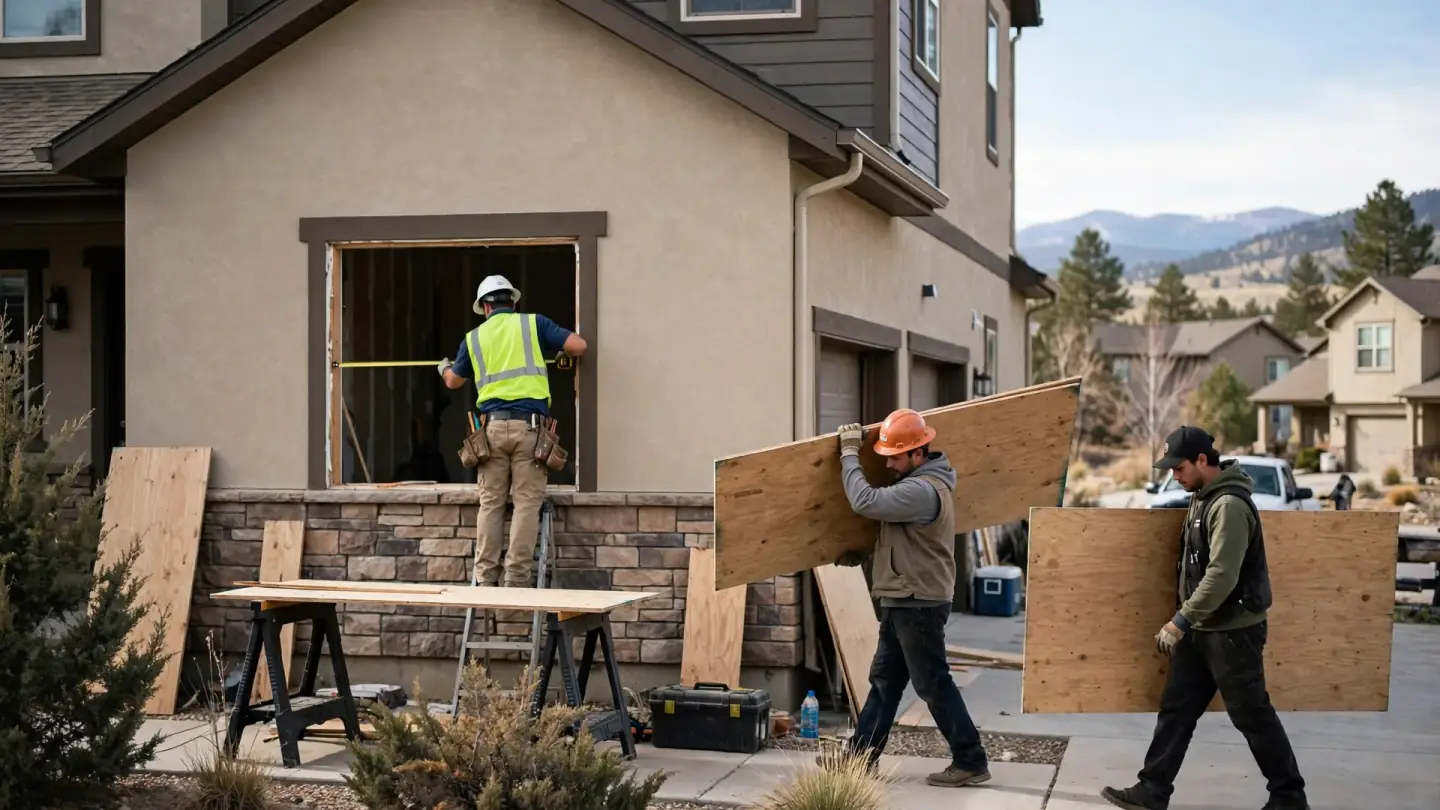
Key facts: Board-Up and Tarping
- Firefighters often break windows, force doors and cut roof openings to ventilate a fire, leaving the house open afterward.
- Most homeowners policies expect owners to take reasonable steps to protect property from further damage after a loss.
- Board-up uses plywood fastened to the frame or with through-bolts; roof tarps are anchored with battens, not just weights.
- Colorado Springs weather can bring strong downslope winds, hail and spring snow, which quickly damage an open house.
Why it is needed
Why a burned house needs securing right away
Firefighting is rough on a building by design. To reach the fire and let out heat and smoke, crews break windows, force doors, pull ceilings and sometimes cut holes through the roof. Those actions save houses, but they also leave openings everywhere. Glass may be gone from several windows, the front door may not lock, and the roof may have a hole above the room that burned.
An open house is exposed to three problems. Weather comes in: snow, rain and wind add water damage to rooms that only had smoke damage. Animals and birds come in. And people come in, whether curious neighbors, scrappers looking for copper or anyone looking for something to take. Securing the property stops all three and protects whatever can still be cleaned and restored.
Most homeowners policies include a duty to protect property from further damage after a loss. Insurers generally expect reasonable steps, such as covering openings, and they may question new damage that happened because the house was left open. Board-up and tarping are usually among the first jobs after a fire for that reason.
Openings
Openings that usually need securing after a fire
Broken windows
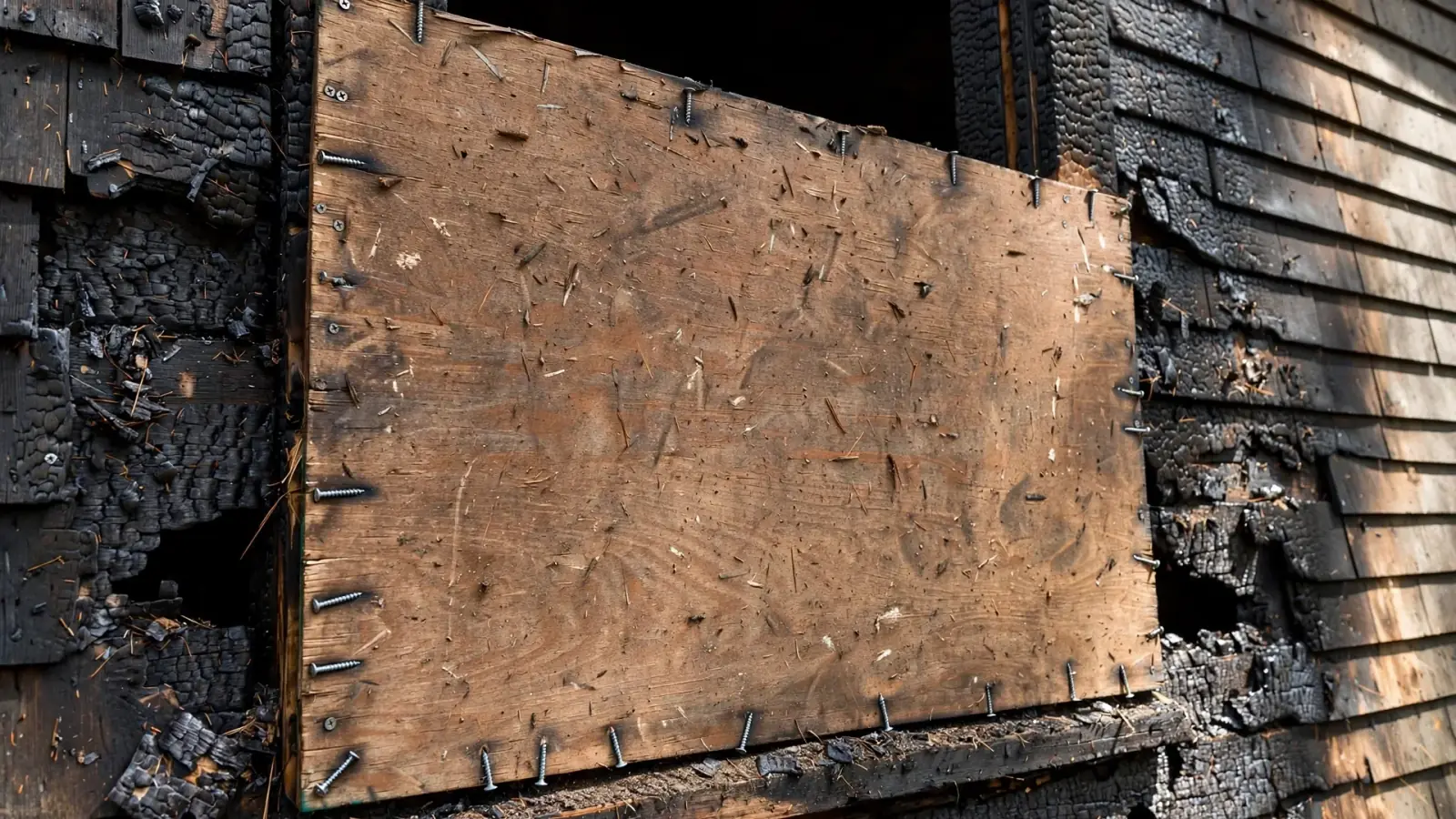
Windows broken by heat or by firefighters for ventilation are covered with plywood on the outside or inside.
Forced or burned doors
Entry doors and garage service doors that no longer lock are boarded, or replaced with a secured plywood door with a lock.
Roof ventilation holes
Openings cut to vent heat are covered with tarps or with plywood decking and then tarped.
Burned-through roofing
Areas where roofing and decking burned through are covered and sealed against snow and rain.
Garage doors
Damaged overhead doors may be secured with bracing or plywood if they cannot be closed and locked.
Exterior wall openings
Holes where siding and sheathing burned are covered with plywood or heavy plastic sheeting.
Method
How a fire-damaged house is boarded up and tarped
- 1
Walk the outside first
The contractor walks the exterior with you, listing every opening and checking that walls and roof areas are safe to work on.
- 2
Photograph before covering
Each opening and the damage around it is photographed, so the insurer can see conditions before they are hidden.
- 3
Board windows
Plywood is cut to size and fastened into the frame or wall framing with screws, or held with through-bolts and backer boards for added security.
- 4
Secure doors
Doors that cannot lock are covered or replaced with a plywood door fitted with a hasp and padlock, so you can still get in.
- 5
Tarp the roof
Heavy tarps are laid over openings and extended over the ridge where possible, with edges fastened under wood battens so wind cannot get underneath.
- 6
Check inside
Openings on the inside, such as ceiling holes into the attic, are reviewed so that snow or water entering the attic does not reach the rooms below.
- 7
Leave a record
You receive a list of what was covered, photos, and how to reach the boarded doors safely.
Methods compared
Common securing methods for fire-damaged houses
| Method | Used for | Strengths | Limits |
|---|---|---|---|
| Plywood screwed into frame | Windows and doors on most houses | Quick, sturdy, reusable | Leaves screw holes in trim |
| Through-bolted plywood with backer boards | Ground-floor windows and long vacancies | Hard to remove from outside | More time to install |
| Plywood door with hasp | Main entry while repairs wait | Gives owner and contractor access | Needs a padlock and key control |
| Roof tarp with battens | Vent holes and burned roof areas | Sheds snow and rain | Needs checking after storms |
| Plywood decking plus tarp | Large roof holes | Supports snow load and foot traffic | Requires safe access to framing |
| Plastic sheeting | Interior openings, small exterior gaps | Quick temporary barrier | Not secure; tears in wind |
Local weather
Colorado Springs weather and an open house
Colorado Springs weather changes quickly, and that matters for a damaged house. Strong westerly winds come down off the mountains, especially in winter and spring, and can lift poorly fastened tarps and plywood. Hail is common in late spring and summer thunderstorms along the Front Range. Snow can fall from autumn into late spring, and a single storm can drop a heavy load onto a roof that has already lost part of its decking.
That is why local crews anchor tarps under battens and extend them over the ridge where they can, rather than relying on sandbags or tires, and why they use screws rather than nails on plywood. It is also why a secured house should be checked after each storm or high-wind day until permanent repairs begin. Ask the contractor who will check the property and how you will be told if something has moved.
Security
Keeping an empty fire-damaged house secure
- Remove valuables, documents, medicines, firearms and small electronics once the fire department allows you in.
- Lock or board every door, including basement and garage service doors.
- Tell your neighbors the house will be empty and ask them to report anyone on the property.
- Ask the utility whether gas and power should stay off while the house is unoccupied.
- Keep a record of who has keys or padlock combinations.
- Visit regularly, and after storms, to check boards and tarps; photograph any changes.
- If you see signs of entry, contact the police and your insurer.
Wildfire areas
Securing houses after a wildfire in the foothills
After a wildfire, houses that survived near burned ones often have broken windows from heat, scorched siding, damaged vents and roofs pocked by embers. In neighborhoods like Mountain Shadows after the Waldo Canyon Fire, many homes that were not destroyed still needed securing and cleaning. [4] Access may be restricted for days while officials check roads, utilities and hazards.
Once access opens, boarding broken windows and covering roof damage keeps ash, wind and weather out while cleanup is arranged. Utilities may be off; after Waldo Canyon, Colorado Springs Utilities restored gas to thousands of undamaged homes one by one, checking meters and relighting pilots. Plan board-up work around those visits so crews can get in.
Insurance
Board-up, tarping and your insurance claim
Securing the property is usually considered part of mitigating further damage, and many policies treat reasonable emergency protection as part of the claim. Keep invoices, photos and the contractor's list of what was covered. Tell your insurer that the house has been secured and by whom.
If the insurer wants to see conditions before the house is covered, photographs and video taken before board-up usually satisfy that need. Do not delay securing the house while waiting for an adjuster visit if weather is coming. The guide working with your insurance adjuster explains documentation in more detail.
Your role
What you and the contractor each handle when securing a house
| Task | Homeowner | Contractor |
|---|---|---|
| Get fire department release | Yes | Confirms before work |
| Remove valuables and documents | Yes | Can help move items to a safe room |
| Photograph damage | Yes, as soon as safe | Also photographs each opening |
| Board windows and doors | No | Yes |
| Tarp roof openings | No | Yes, with fall protection |
| Check after storms | Drive-by checks | Repairs any movement |
| Tell the insurer | Yes | Provides invoice and photos |
Interior protection
Protecting what is inside once the house is secured
Securing openings is the first step in protecting contents. Once the house is closed up, belongings that can be saved should be moved away from wet or sooty areas, and anything that needs specialist cleaning can be packed out. Interior openings such as holes in ceilings into the attic may be covered with plastic sheeting to keep insulation and debris from falling into the rooms below.
If firefighting water is still present, drying should start as soon as the house is secure, because a closed, wet house invites mold. That work is described on water damage from firefighting, and the movement of belongings is covered on contents pack-out and cleaning.
Garage and outbuildings
Garages, sheds and outbuildings
Attached garages are a common starting point for house fires, and detached garages, barns and sheds are common on larger lots in places like Black Forest. A burned garage often has a jammed overhead door, broken windows and a damaged roof, and the shared wall with the house may be compromised. Securing it matters because it often gives direct access to the house.
Fuel cans, propane cylinders, pool chemicals and batteries stored in a garage can be damaged by heat. Leave them where they are, tell the contractor and fire department about them, and follow local guidance for disposal rather than moving them yourself.
Prevention
Making a house easier to secure next time
A few things make securing a house easier if it ever has to happen: knowing where your main water, gas and electrical shut-offs are; keeping copies of insurance documents and a home inventory outside the house; and, in the wildland-urban interface, following the city's guidance on ignition-resistant construction and defensible space so that a nearby wildfire is less likely to break windows and ignite the structure. [7]
Ready.gov and the NFPA both recommend that households plan for fires in advance, with working smoke alarms, two ways out of each room and a meeting place outside. [6] These plans are aimed at safety, not property, but a family that leaves quickly and safely is the first priority in any fire.
How long
How long boards and tarps can stay in place
Board-up and tarping are temporary by design. Plywood over windows and doors can stay for months if fastened well and checked, but tarps degrade in strong sun and wind, and the sun at Colorado Springs' elevation is intense. A tarp that looked secure in October may be shredded by March. Ask the contractor how long their tarp is expected to last and when it should be replaced if roof repairs are delayed.
If permanent repairs will take a long time, for example while an insurance claim is settled or plans are approved, consider a more durable temporary roof covering with plywood decking and heavy tarp or temporary membrane, and schedule regular checks.
Glass and debris
Broken glass and debris around a burned house
Before anyone boards a window, broken glass has to be dealt with. Shards left in frames can fall when plywood is fastened, and glass scattered on the ground, in flower beds and on decks is a hazard for children, pets and the crew. Contractors usually clear loose glass from frames, sweep the immediate area and bag the debris before fastening plywood. Tempered glass from patio doors breaks into small cubes that spread widely and need careful cleanup.
Fire debris on the ground around the house, such as fallen gutters, burned siding and roofing, can be left for the cleanup and rebuild stage unless it blocks access or is a hazard. Ask the contractor what they will clear during board-up and what will wait. Do not burn debris on the property or dump ashes outdoors; Colorado Springs' dry grass and wind spread fire quickly, as the 2022 grass fire that forced about 500 homes in Stetson Hills to evacuate showed.
On the call and at the property
What happens when you call about securing a house
- 1
Describe the openings
On the call, list the windows, doors and roof areas that are open, whether the house is one or two stories, and whether the fire department has released it.
- 2
Agree access
Tell the contractor how to reach the property, whether you will be there, and whether utilities are on.
- 3
Arrival and survey
The crew walks the exterior, photographs every opening and confirms with you which ones to secure and how.
- 4
Securing
Windows and doors are boarded, roof openings tarped, and one entry fitted so you can still get in.
- 5
Hand-over
You receive photos, a list of what was done, and the means to open the secured entry.
What to tell the contractor
Details that help a board-up crew plan
- Approximate number and size of broken windows on each side of the house.
- Whether the roof has holes cut by firefighters or burned-through areas, and roughly where.
- Whether there are skylights, sliding doors or garage doors that are damaged.
- Whether the house will be empty, and for how long you expect it to be.
- Any hazards you noticed: sagging rooflines, downed wires, propane tanks or damaged decks.
- Whether there are pets or livestock on the property that need to be kept clear of the work.
Skylights and sliders
Skylights, sliding doors and large windows
Some openings need more than a sheet of plywood. Skylights are on the roof, often above the room that burned, and a broken or heat-damaged skylight is effectively a hole in the roof. It is usually covered from above with plywood and then tarped along with the surrounding roof. Large picture windows and sliding patio doors need plywood sized to span the whole opening and fastened into solid framing around it, because a large panel catches a lot of wind.
Where a slider is still in its track but the glass is cracked, the contractor may cover it on the outside and leave it closed, or remove the panel and board the opening. Either way, make sure at least one door remains usable so you, the contractor and your adjuster can get in.
Snow load
Tarps, plywood and snow on a damaged roof
Snow is a real concern on fire-damaged roofs along the Front Range. Wet spring snow is heavy, and a roof that has lost decking or has weakened rafters may not carry it. Tarps alone do not carry snow; they only shed water. Where a roof opening is large, contractors often install plywood decking over sound framing before tarping, so the covered area can carry snow and shed it without the tarp sagging into the hole and filling with water.
After a storm, check from the ground for sagging, ponding on tarps or snow sliding off in one spot. Do not climb onto the roof to clear snow; call the contractor if something looks wrong.
Fencing
Temporary fencing around a badly damaged house
When a house is severely damaged, boarding openings may not be enough. Collapsed sections, exposed foundations, debris piles and open basements are hazards for anyone who walks onto the lot, including children. Temporary construction fencing around the property keeps people out, signals that the site is being managed, and gives crews a secure work area. Ask the contractor whether fencing is advisable for your house and how it will be anchored against wind.
FAQ
Board-up and tarping questions
Why did firefighters break my windows?
To let out heat and smoke and to reach the fire. Ventilation lowers temperatures and improves visibility for crews inside, which helps them stop the fire.
Do I need to board up my house after a fire?
If windows, doors or the roof are open, yes. Securing the house protects it from weather, animals and trespassers, and insurers generally expect reasonable steps to prevent further damage.
Will insurance cover board-up and tarping?
Many policies treat reasonable protection after a covered loss as part of the claim, but terms vary. Keep invoices and photos and tell your insurer.
Can I board up the house myself?
Ground-floor windows can be covered by a capable homeowner if it is safe, but roofs and upper floors should be left to a crew with fall protection. Photograph everything first.
How do I get into a boarded-up house?
Ask for a plywood door with a hasp and padlock on one entry, and keep track of who has the key or combination.
How long does a roof tarp last?
It depends on weather and installation. Strong sun and wind wear tarps out; check after every storm and ask your contractor when it should be replaced.
Should I stay in a house that has been boarded up?
Only if the fire department and the contractor agree it is safe, the utilities are working, and smoke residue is limited. In most cases families stay elsewhere until cleaning is done.
What if someone breaks into my boarded house?
Report it to the police and your insurer, photograph the damage, and have the opening secured again.
How soon should a house be boarded up after a fire?
As soon as the fire department releases it, and before the next storm or night if possible. Open houses are exposed to weather, animals and trespassers.
Sources and citations
- [1]U.S. Fire Administration — After a fire
- [2]U.S. Fire Administration — After the Fire: Returning to Normal (FA-46)
- [3]KRDO — Gas service gradually returns to Mountain Shadows (2012)
- [4]Wikipedia — Waldo Canyon Fire
- [5]Ready.gov — Home fires
- [6]NFPA — Home fire safety
- [7]City of Colorado Springs — Wildland-urban interface construction requirements
- [8]KRDO — Grass fire near Stetson Hills Boulevard forces evacuations (2022)